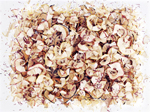
Eric Klemm: Close Shavings by Gary Michael Dault

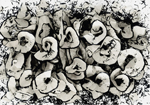
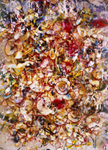
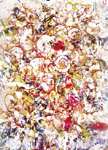
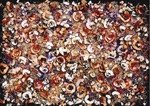
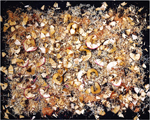
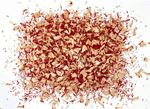
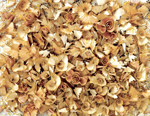
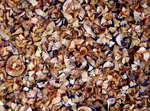
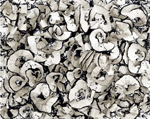
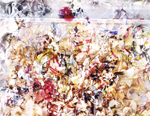
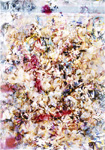
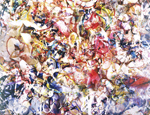
Any first encounter with Eric Klemms demonically lush and almost endlessly explorable large-scale photographs of various kinds of shavings is likely to seem both astonishing and a matter of almost immoderate wit.

Their wit is generated from our seeing straightaway that the photographs, as pure construct, are indeed of shavings and it seems immediately absurd that any material so abject should be so easily transformable into arrangements (many of them floral in feeling) that are so opulent, so laden with a sense of decorative history, so embarrassingly authoritative in their painterly forcefulness.

And astonishing, because of the generative power with which they all seem equally imbued: a formal, imagistic power which compels us to see in them (so elastic are they in their visual complacency) everything from nosegays of flowers (the shavings often form persuasive roses and pansies), to wreaths, to spheres and discs of blossom, to doormats of the stufffields of texture, planes of variegated colour as vast and intricate as meadows.

Like whorls and patches of pigment itself, Klemms conceptually honed shavings, whether accumulated into congested planes or gently spread out like delicate specimens on a microscope slide, clamour for their own formal integrity as well as that which the artist has suggested for them. In essence, the shavings-works constitute one long and continuing paradox: they are blatant in their beauty and, at the same time, ironic about it to the point of coyness; they are as foolishly over-the-top as a bedroomy, talcum-powdered greeting card, and yet, like a greeting-card somebody really believes in, are touchingly guileless and innocent; they seem natural but, of course, they are shamelessly manipulated; they exist within a flatness as flat any photographic surface can provide, and yet the little spikes and spirals, curls and shards of which Klemms accumulations of shavings are made up constitute an absorbing pictorial tapestry of faux cavities and spurious volumes (one of the keys to their being read as photographed paintings).

In the end, Eric Klemms diabolical shavings are dangerously glamorous to the point of being saccharine, and satisfyingly cynical to the point of being aloof. In the end, they both withdraw from the viewer and, at the same time, stridently insist on their ingenuous loveliness.

Toronto, March 3, 2007.


Eric Klemm Shavings by Dion Kliner

From a distance, the overall effect of Eric Klemm's Shavings, for which he won Third prize at the PX3 Prix de la Photographie Paris in the category Fine Art / Abstract, is an allover glimmering and flickering of Impressionist or Pointillist flecks of color as in Untitled No. 10. Against their black and white backgrounds they glow like galaxies and confetti. Close up the pictures resolve themselves into massive compositions made from the shavings of colored pencils. They resemble flower petals, and the peels of apples, pears, and lemons, their color seen on their thin edge next to the white of their meat; and in Untitled No.s 9, 3, and 5, fireworks, the small shavings like sparks, the large pieces and spiral whorls like the initial bursts of red, white, and blue against night skies. As in each of his many other series, including the forthcoming book Silent Warriors - Portraits of North American Indians, the photographs are impeccable. One sees in these deceptively simple-looking, yet complex Shavings that it isn't the subject that makes the picture, it's the photographer. That truth is borne out by the albums, computer memory, and galleries filled with dull snapshots. Sometimes fragile and weightless, other times looking dense and heavy, the Shavings create a range of sensations which is impressive for so limited a means. They are surprisingly deliberate in their compositions, but also offhanded and perfectly natural, which is to say they appear easy and assured.

At the same time that the Shavings are emphatically themselves, it is hard not to also be reminded of other art. The white of Klemm's Untitled No. 14, with periwinkle blue and violet like shadows, like Robert Ryman's accumulations of white pigment; the round-edged red rectangle of Untitled No. 2, like the pinks and reds of Philip Guston's brushstrokes as they coalesce into anomalous forms in his paintings of the 1950's; Untitled No. 13, where the predominant color is the creamy white of the pencil's raw wood, yet the impression, given only by the fine edges and the pigment of its core, is of blackness, like the thick, black oilstick drawings of Richard Serra; or Untitled No. 12, like Jackson Pollock's Untitled (Scent). I couldn't tell you why. They don't look like any of those things, but they bring them all to mind. I also can't help thinking about two other artists, Sosos of Pergamon and James Whistler. The Roman naturalist and writer Pliny the Elder, tells the story of Sosos, the most celebrated Greek mosaicist. At Pergamon he laid the floor which became known as the Unswept Room on which he represented the scraps from a dinner-table, and other sweepings, as though they had been left there. The story of Whistler is better known. In 1874 Whistler painted Nocturne in Black and Gold: The Falling Rocket. After seeing an exhibition including this painting, the eminent critic, John Ruskin published his notorious attack which said in part: I have seen, and heard, much of Cockney impudence before now; but never expected to hear a coxcomb ask two hundred guineas for flinging a pot of paint in the public's face. Whistler sued for libel. While on the stand, Whistler admitted to finishing one of his paintings in a couple of days. The labor of two days, Ruskin's attorney contemptuously followed, is that for which you ask two hundred guineas? No, Whistler replied, I ask it for the knowledge I have gained in the work of a lifetime.

I imagine Klemm, Whistler, and Sosos connected as fellow travelers through the unremarkable sweepings that Sosos represented, and the piles of shavings swept by Klemm, as if from the floor of a pencil factory, into circles and rectangles; and through the tesserae of Sosos' mosaic, the flecks of Whistler's Nocturne fireworks, and Klemm's pieces and fragments of color. I imagine Sosos being contemptuously asked why he's wasting his time representing fishbones, bones, and empty shells, and Klemm being similarly questioned about pencil shavings. And I imagine these three, each bent over their respective work, Sosos with his small pieces of stone and glass, Whistler with his paintbrushes, and Klemm with his shavings, connected though history by a shared bringing to bear of all they had on what was usually overlooked.

No subject is too imposing, none too inconsequential to escape being captured by Klemm as uniquely worthy of attention. All Klemm's skill and experience, all the knowledge he's gained in the work of a lifetime, has been brought to bear on nothing more than piles of pencil shavings. And under his loving attention they become radiant. They are simply beautiful.